Strengthening Community Engagement for El Niño Awareness and Preparedness in Puntland
Author
IRIS Research Center
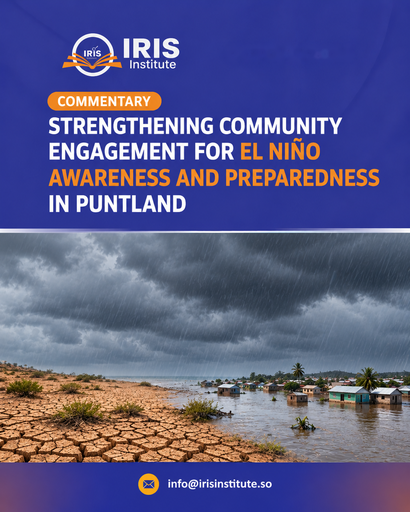
Strengthening Community Engagement for El Niño Awareness and Preparedness in Puntland
Somalia is entering the October–December 2026 Deyr rainy season amid growing concerns about heavy rainfall, flash and riverine flooding, displacement, food insecurity, and water-borne diseases. The strengthening of El Niño conditions adds to these concerns.
For Puntland, the challenge is not simply whether early-warning information is available. The more important question is whether that information actually reaches the people most exposed to the risks—and whether they can understand it and act on it in time.
Authorities, humanitarian organizations, and development partners are investing in early-warning systems, preparedness measures, and the pre-positioning of assistance. These efforts are important. However, early warning is only effective when communities receive information through channels they trust, in language and formats they understand, and early enough to take action.
The Information Gap Matters
A major weakness in disaster preparedness can be the gap between producing information and reaching communities. Awareness campaigns often concentrate on major towns and urban populations, while pastoralists, farmers, rural communities, internally displaced people, women, and other vulnerable groups may receive less information.
This raises an important concern: Are current communication approaches designed around the needs of communities, or around the communication systems that institutions already have?
If awareness campaigns mainly depend on social media, written materials, or technical messages, they may not adequately reach remote and pastoral communities. Puntland's diverse population requires a more community-centered approach.
Communication Must Be Designed for Communities
El Niño and flood-related information does not need to be complicated. Communities need to know what is happening, what risks they face, what they should do, and where they can seek assistance.
For this reason, awareness materials should prioritize Somali-language communication, simple wording, illustrations, audio messages, short videos where appropriate, and practical local examples. Materials should also consider different literacy levels.
Producing technically accurate information is not enough if the intended audience cannot easily understand or use it.
One Communication Channel Is Not Enough
Social media can be useful, particularly in urban areas, but it should not become the main approach for reaching Puntland's rural and pastoral communities.
Local radio, community meetings, religious and traditional leaders, community-based organizations, mobile awareness teams, public announcements, health workers, extension workers, and existing community networks can all play an important role.
The strongest approach is therefore not to replace one communication channel with another, but to combine multiple trusted channels so that warnings can reach communities before hazardous conditions occur.
Communities Should Help Design the Messages
Another important issue is who designs awareness materials.
Messages intended for communities should not be developed entirely without their participation. Pastoralists, women, youth, community leaders, religious leaders, local authorities, and other community representatives can help identify whether messages are understandable, culturally appropriate, and realistic.
Before materials are widely distributed, they should be tested with the people who are expected to use them.
A simple question should guide this process: Can people understand the message and realistically act on what it recommends?
If the answer is no, the communication approach needs to be reconsidered.
From Awareness to Action
Puntland does not simply need more information about El Niño. It needs information that leads to action.
Telling communities that heavy rainfall or flooding may occur is only the first step. Effective messages should clearly explain:
- What is happening?
- Who is at risk?
- What should people do?
- Where can they get help or more information?
This is the difference between awareness and preparedness.
Early-warning systems should ultimately help people make decisions before a crisis occurs. If communities receive warnings but do not know what action to take, the warning system has only achieved part of its purpose.
Conclusion
The effectiveness of El Niño preparedness in Puntland will depend not only on the quality of forecasts and early-warning systems, but also on the ability to connect those warnings with communities.
More information does not automatically mean better preparedness. What matters is whether information reaches the right people, in the right form, through trusted channels, and early enough to support action.
Puntland's preparedness efforts should therefore place communities at the center of risk communication. The goal should not simply be to inform communities about El Niño, but to ensure that communities can understand the risks, identify what they can do, and act before those risks become disasters.
Topics & Regions
Related Analysis
Dormant, Not Defeated: Why Somali Piracy Is Emerging Again

Puntland’s Rising Prices: Impact of the Middle East War and Global Disruptions
Drought Crisis and Policy Responses in Puntland; Impacts, Challenges,and Strategic Actions
Drought in Puntland