
Dormant, Not Defeated: Why Somali Piracy Is Emerging Again
Author
IRIS Research Center

Dormant, Not Defeated: Why Somali Piracy Is Emerging Again
The Return of a Supposedly Defeated Threat
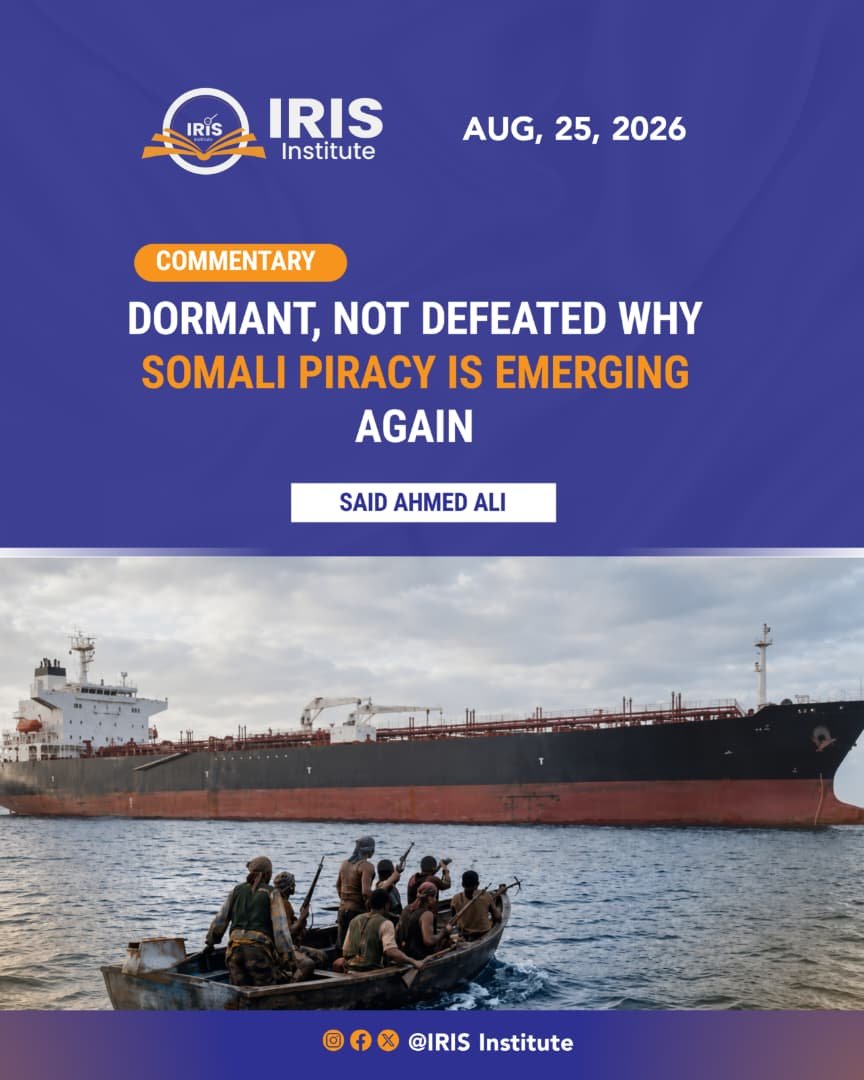
Somali piracy was once treated as one of the world’s most serious maritime-security threats. This classification, while accurate in terms of risk, frequently overlooked the coastal socio-political landscape that allowed such threats to emerge. Between 2005 and 2011, the scale of the crisis was staggering, with as many as 1,099 ships attacked and more than 200 hijacked. The subsequent collapse of this criminal enterprise was equally dramatic. The World Bank dataset records no new hijacking from 2013 to mid-2015. Renewed attacks in the 2023 to 2026 period do not yet show a return to those historical peak years, but they demonstrate clearly that the conclusion that piracy was "defeated" was far too strong. In my view, we mistook a temporary cessation of activity for a total destruction of the capability. The primary proof of this miscalculation arrived with the hijacking of the MV Ruen in late 2023, which ended the "dormant" period and proved that the pirate infrastructure was still intact and functional after six years of silence. This resurgence was further accelerated by the hijacking of the MV Abdullah in April 2024, where a $5 million ransom was paid. This specific payment served as the "proof of profit," acting as a psychological trigger that motivated other youth to head back to sea. As of mid-August 2026, the state of piracy is increasingly dire. Four vessels remain in pirate hands off the Somali coast. The MT Honour 25, a Palau-flagged oil tanker boarded on 21 April while sailing toward Mogadishu with fuel, continues to be held with seventeen crew members, mostly Pakistani, whose health is visibly failing after four months in captivity. The MV Sward, a Saint Kitts and Nevis-flagged cargo ship hijacked on 26 April with a crew of fifteen, remains held without resolution. The MT Eureka, seized on 2 May at anchor in Yemen's Qana Port, has seen pirates demand a staggering $10 million ransom, among the largest sums sought during this resurgence, to release the vessel and its twelve crew. Most recently, the MT Asana, a Tanzanian-flagged tanker taken on 17 July off Yemen, is murkier still, with questions raised about its cargo, ownership, and destination suggesting it may not be a straightforward ransom case. Roughly 50 seafarers are now awaiting negotiation as international naval forces, including Operation Atalanta, have limited ability to intervene directly while these ships are anchored close to shore in Somali waters.
The better interpretation is that international actors successfully suppressed piracy by changing the economics of attack, without necessarily removing every condition that could make piracy viable again. This highlights a critical oversight we mistook temporary stability for permanent peace. The current episode therefore tests whether maritime security can survive when exceptional external protection is redirected or unevenly distributed across the region. My assessment is that the central failure was not the suppression itself, but the failure to convert that suppression into a durable, self-sustaining Somali capability. I argue that by prioritizing naval steel over coastal governance, the international community built a house on sand. The return of Somali piracy is not a random occurrence but an indicator of the structural roots that remain unresolved beneath the surface of the water.
The Suppression Paradox
The international response to the initial piracy crisis worked operationally. Naval patrols increased the risk of interception. The employment of armed guards and vessel-protection measures significantly raised the costs of boarding. Enhanced intelligence-sharing and successful criminal prosecutions added further costs to the pirate business model. Research from the World Bank and other international analysts supports this interpretation. Calling the naval response a failure would misunderstand the evidence of a decade of relative calm. However, we must ask if this calm was merely a forced silence rather than a genuine resolution. A major cause of this resurgence was the "Open Door" created by a strategic security reallocation. Specifically, the Puntland Maritime Police Force (PMPF) was moved away from strategic coastal areas like Mudug and the Garacad shoreline to fight Al-Shabab and ISIS in the Bari and Sanag mountains. This redeployment left the traditional piracy hubs unguarded, physically proving how the "arm of deterrence" was removed and allowing pirates to operate again with less oversight.
However, operational success is not the same as structural elimination. The response made piracy less profitable and less feasible at sea, but it did not, by itself, create a unified Somali maritime authority, reliable coastal law enforcement, secure fisheries governance, or a broad, legitimate coastal economy. My analytical perspective is that security was effectively "rented" from foreign powers rather than "owned" by the Somali state. The practical lesson is that maritime threats remain capable of shifting and recurring when no domestic security environment replaces external enforcement. This is the suppression paradox: external force can extinguish visible activity while leaving the vulnerability to changed incentives completely intact. It is my contention that deterrence was treated as a ceiling when it should have been the floor. Deterrence should therefore be treated as a bridge to institutional consolidation, not a substitute for it.
Why Now? The Changing Opportunity Structure
The timing of renewed attacks matters. In early 2024, reports began to circulate that Somali pirates, dormant for nearly a decade, were taking advantage of a security vacuum associated with the wider crisis involving Houthi attacks in the Red Sea. This suggests a calculated opportunistic shift rather than a spontaneous resurgence. The maritime crisis in the region has been exacerbated by the withdrawal of specialized security forces, which coincided with the redirection of naval assets to address Houthi threats. This suggests a plausible mechanism. When ships reroute to avoid missile threats, naval attention is divided, and response times for traditional piracy incidents change, the expected cost of an attack falls.
But plausibility is not the same as causation. The available evidence does not isolate a single factor, such as Red Sea diversions or the removal of the maritime High Risk Area designation. Instead, the evidence supports a broader security-vacuum mechanism. I believe the pirates demonstrated a sophisticated understanding of regional geopolitical shifts. The 2025 record remained mixed, with global piracy incidents rising while Indian Ocean incidents appeared to fluctuate. However, by July 2026, the situation had shifted significantly. EUNAVFOR Atalanta reported four ongoing incidents involving vessels held near Somalia and 67 crew members in captivity. Their updates recorded a steady increase in piracy-related incidents since the beginning of that year.
Recent reporting has described tanker hijackings and a lighter protection environment in the Gulf of Aden compared to the more heavily patrolled Indian Ocean. A "renewed and operationally significant resurgence" is now a more accurate description than a tentative "re-emergence," even while the total activity remains far below the historical peaks of 2011. Their tactical agility suggests that the pirate networks remained observant and ready throughout their period of dormancy. The pirates have proven they can adapt to the changing opportunity structure of the regional security environment.
The Pirates’ Onshore Infrastructure
Piracy is not simply a matter of poor fishermen improvising criminality. Historical research describes a sophisticated system in which clan elders and, at times, local militias protected hijacked ships, resolved internal conflicts, and enabled vessels to move along the coast without being re-hijacked after ransom payments. Piracy depended on a complex web of protection and coordination ashore involving financiers, recruiters, boats, fuel, weapons, intelligence, and the management of multi-million dollar ransoms. This infrastructure requires a high degree of social and financial organization that cannot be built overnight.
This raises a critical question. Did these networks ever truly disappear? While we must be careful not to infer continuity without contemporary network evidence, my judgment is that organized piracy is much easier to restart where maritime knowledge, local protection, and logistics remain available in the coastal clusters. I contend that the speed of the resurgence strongly points toward a latent organizational structure that merely transitioned into other illicit trades. The PMPF strategic shift from the Mudug/Garacad coastline to the northern Bari and Sanag mountains is proof of how the removal of onshore oversight allowed this infrastructure to re-engage with the sea. If the financial and logistical "muscle memory" of piracy survives in the shadows of other illicit trades, such as trafficking or smuggling, then the structural roots are deeper than a simple lack of jobs. The ability to reactivate these networks quickly suggests that the onshore infrastructure was dormant, not destroyed.
The Governance and Livelihood Gap
The governance problem in Somalia is real, but it should not be reduced to a simple narrative of poverty. Research indicates that countries with significant Illegal, Unreported, and Unregulated (IUU) fishing face a much greater risk of piracy, especially where state fragility and valuable fisheries coexist. The plausible mechanism here involves grievance, lost legal income, weak enforcement, and recruitment opportunity. However, it is essential to remember that grievance is not causation, and illegal fishing does not legitimize the taking of hostages. In my view, IUU fishing serves as the moral fuel that pirates use to justify their criminal engine. These persistent grievances have been revived as foreign vessels deplete local tuna and lobster stocks, fueling the "defensive" narrative used to justify piracy to the community.
We must keep three propositions distinct. First, that IUU fishing is a major governance failure. Second, that coastal communities can use this failure in narratives to legitimize criminal activity. Third, that pirate groups actively exploit these narratives to secure social license for their operations. Addressing the structural roots requires us to see IUU fishing as more than just a resource problem. It is a direct threat to state legitimacy. This is exacerbated by an acute economic crisis. International humanitarian funding dropped from $1.42 billion in 2025 to $852 million in 2026, a 40% decrease, stripping away the safety net for families and leaving them with no legal way to survive. Furthermore, systemic unemployment persists. Despite the construction of major infrastructure like the Garacad Port, there is a lack of actual jobs for local youth as the port has yet to fulfill its promise as a sustainable employer. This creates a "Demonstration Effect," where young men see their peers making life-changing amounts of money in weeks through hijackings, making the risk of piracy look more attractive than the slow death of poverty.
From Foreign Suppression to Somali Ownership
The fundamental task for Somalia and its partners is to convert external suppression into national capability. This requires focusing on three specific priorities.
First, Somali maritime security needs an accountable and functional operational core. This includes the capacity of the federal coast guard and the Puntland maritime police, as well as improved surveillance, intelligence, and coastal patrols. I believe that without a unified command structure, even the best-trained local forces will remain reactive rather than proactive. The ultimate objective is a Somali-led chain of custody that can detect, intercept, investigate, and punish piracy within a legal framework.
Second, fisheries governance and coastal development should be treated as security policies as much as they are development policies. Programs aimed at sustainable fisheries and the blue economy, such as fish processing, port management, and maritime services, are essential. My assessment is that economic empowerment is the most effective deterrent against criminal recruitment. These measures can raise the opportunity cost of joining a pirate crew and reduce the political space in which predatory actors claim to represent the interests of coastal people.
Third, prevention must reach the communities themselves. Local authority remains central because elders and local leaders have historically shaped whether piracy can operate from the shore. Genuine security cannot be imposed from above. It must be built from the ground up through local trust. Community-based reporting, transparent fisheries enforcement, and credible employment for youth can make piracy much harder to organize and even harder to defend.
Conclusion
The resurgence of Somali piracy does not invalidate the success of the international response over the last decade. Rather, it exposes its inherent limits. Naval power and shipboard protection made piracy unprofitable for a time, but they did not prove that Somalia’s maritime political economy had been repaired. The lesson is clear, suppression is a recurring expense, while ownership is a lasting investment. The evidence from 2026 supports the reality of an operationally significant resurgence, even if it is not a return to the peak years of the past.
Durable prevention requires Somali-owned maritime security joined to credible fisheries governance and genuine coastal opportunity. The decade of dormancy was a success of suppression, but it was not proof of a permanent resolution. I maintain that we are witnessing the inevitable result of neglecting the land-based origins of maritime crime. The combination of security reallocation, the $5 million "proof of profit" from the MV Abdullah, and the 40% aid funding gap has created a perfect storm. To stop the cycle of resurgence, the focus must shift from the symptoms of piracy at sea to the structural roots on land. Unless the underlying political and economic conditions are addressed, the threat will remain dormant only until the next change in the regional security environment. We must move beyond managing the crisis to finally solving it.
References
BBC News. (2024, April 15). Somali pirates receive $5m ransom for MV Abdullah. https://www.bbc.com/news/articles/c7vg6dml34vo
Do, Q. T., Ma, L., and Ruiz Ortega, C. (2016). Pirates of Somalia: Crime and deterrence on the high seas. World Bank Group. https://doi.org/10.1596/1813-9450-7757
EU Naval Force Somalia Operation Atalanta. (2026, August). Update of the ongoing piracy incidents off the northern coast of Somalia. https://eunavfor.eu/index.php/news/update-ongoing-piracy-incidents-northern-coast-somalia
Horseed Media. (2026, July 25). Ghost tanker: MT Asana hijacking exposes unanswered questions over cargo, ownership and destination. https://horseedmedia.net/ghost-tanker-mt-asana-hijacking-exposes-unanswered-questions-over-cargo-ownership-and-destination/424123/
Horseed Media. (2026, August 15). Burcad-badeedda haysta MT Honour 25, oo afduubku la galay bishii afraad [Pirates holding MT Honour 25, hijacked in the fourth month]. https://horseedmedia.net/burcad-badeedda-haysta-mt-honour-25-oo-afduubku-la-galay-bishii-afraad/424837/
International Maritime Organization (IMO). (2026). Reports on acts of piracy and armed robbery against ships: Annual report 2025 (MSC.4/Circ.270).
Mitchell, S., and Schmidt, C. (2023). Insecure fisheries: How illegal, unreported, and unregulated fishing affects piracy. Conflict Management and Peace Science, 40(5), 517–537. https://doi.org/10.1177/07388942231174174
Paravicini, G. (2024, March 21). Somali pirates return, adding to global shipping crisis. Reuters. https://www.reuters.com/world/africa/somali-pirates-return-2024-03-21/
Shortland, A., and Varese, F. (2016). State-building, informal governance and organised crime: The case of Somali piracy. Political Studies, 64(4), 811–831. https://doi.org/10.1111/1467-9248.12227
The Maritime Executive. (2026, May 13). Somali pirates reportedly demand $10M to release small product tanker. https://maritime-executive.com/article/somali-pirates-reportedly-demand-10m-to-release-small-product-tanker
United Kingdom Maritime Trade Operations. (2026, August 14). UKMTO voluntary reporting area overview (Report No. 2). https://www.ukmto.org/-/media/ukmto/products/20260814-ukmto_vra_overview.pdf
United Kingdom Maritime Trade Operations, Joint Maritime Information Center. (2026, August). JMIC advisory update (No. 083-26). https://www.ukmto.org/-/media/ukmto/products/jmic-advisory-update-083-26.pdf
Topics & Regions
Related Analysis

Strengthening Community Engagement for El Niño Awareness and Preparedness in Puntland
Puntland’s Rising Prices: Impact of the Middle East War and Global Disruptions

Drought Crisis and Policy Responses in Puntland; Impacts, Challenges,and Strategic Actions
Drought in Puntland